EF-1 Rocket Project
Mission Objective
Constraint AwarenessProject Briefing
The EF-1 rocket is being developed primarily to experiment with and validate passive roll control, achieved through the addition of carefully canted fins. Its design is a thoughtful optimization, achieving a crucial balance between high performance, affordability, and visual appeal.
- Achieve Level 1 HPR certification
- Safely fly an H-class motor
- Maintain > 2.0 caliber stability
- Validate passive roll control
- Successful parachute deployment at apogee
- Recover without structural damage
Files & Formal Reports

Key Design Decisions
Engineering Methodology Cost Awareness Performance Tradeoff Impulse Class AwarenessMotor Selection
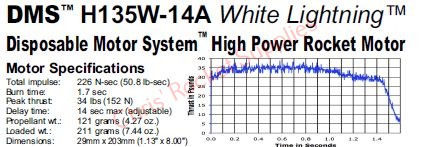
Selected the Aerotech H135W-14A for its 226 N·s impulse and 135 N average thrust, providing sufficient altitude (~2700 ft predicted) while minimizing cost compared to I-class motors.
Airframe Material Trade Study
| Decision Matrix | ||||||||||||||
|---|---|---|---|---|---|---|---|---|---|---|---|---|---|---|
| Airframe Material | Aluminum [1] | Cardboard [2] | BlueTube [AA] | Carbon Fiber | ||||||||||
| Objective | WF | Parameter | Mag. | Score | Val. | Mag. | Score | Val. | Mag. | Score | Val. | Mag. | Score | Val. |
| Density | 5% | g/cm³ | 2.7 | 2.6 | 0.1 | 0.7 | 10.0 | 0.5 | 1.1 | 6.4 | 0.3 | 1.6 | 4.4 | 0.2 |
| Cost | 10% | USD | 53.8 | 1.9 | 0.2 | 10.3 | 10.0 | 1.0 | 35.7 | 2.9 | 0.3 | 300.0 | 0.3 | 0.0 |
| UTS | 10% | MPa | 90 | 1.8 | 0.2 | 15 | 0.3 | 0.0 | 115 | 2.3 | 0.2 | 500 | 10.0 | 1.0 |
| E | 10% | GPa | 70 | 6.7 | 0.7 | 4 | 0.4 | 0.0 | 10 | 1.0 | 0.1 | 105 | 10.0 | 1.0 |
| M1 | 25% | Rank | 1 | 3.3 | 0.8 | 2 | 6.7 | 1.7 | 3 | 10.0 | 2.5 | 1 | 3.3 | 0.8 |
| M2 | 20% | Rank | 2 | 6.7 | 1.3 | 3 | 10.0 | 2.0 | 3 | 10.0 | 2.0 | 2 | 6.7 | 1.3 |
| M3 | 20% | Rank | 2 | 6.7 | 1.3 | 3 | 10.0 | 2.0 | 3 | 10.0 | 2.0 | 1 | 3.3 | 0.7 |
| Overall value | 4.7 | 7.2 | 7.4 | 5.1 | ||||||||||
Conducted a weighted trade study comparing aluminum, cardboard, Blue Tube, and carbon fiber across cost, density, strength, and manufacturability. Blue Tube achieved the highest weighted score due to superior manufacturability and structural adequacy at moderate cost.
Other Materials
All other components are formally justified in the Design Review document
Roll Control
Aerodynamics Physics TheoryThe EF-1 incorporates a 2° cant angle on each of its three trapezoidal fins. This slight angular offset generates a small tangential aerodynamic force during ascent, inducing a controlled roll about the vehicle’s longitudinal axis. The resulting spin provides gyroscopic stiffness, helping to average out minor asymmetries in thrust, fin alignment, and aerodynamic loading.
Unlike active control systems, this method adds no mechanical complexity or onboard electronics, instead leveraging aerodynamic principles to improve directional stability. The cant angle was intentionally limited to balance rotational stabilization with minimal additional drag, ensuring that roll enhancement did not significantly reduce apogee performance.
- 2° fin cant
- Induced roll
- Gyroscopic stability
- Tradeoff vs added drag
Manufacturing
Manufacturing CAD Mill Bandsaw 3D PrintingSimulation & Performance
Other Important Simulation Results
| Parameter | Value |
|---|---|
| Predicted Apogee | 2762 ft |
| Max Velocity | 700 ft/s |
| Stability Margin | ~2.0 calibers |
| Landing Velocity | 18.1 ft/s |
[other plotted graphs will be shown here]
This page is under construction! Come back soon as it is updated weekly!
- Evan Favis
Flight Results
[INSERT PHOTOS HERE]
The rocket achieved stable ascent, clean deployment, and minor cosmetic wear upon landing, satisfying certification criteria.